Snippet — The QUEST Framework for Self-Improvement
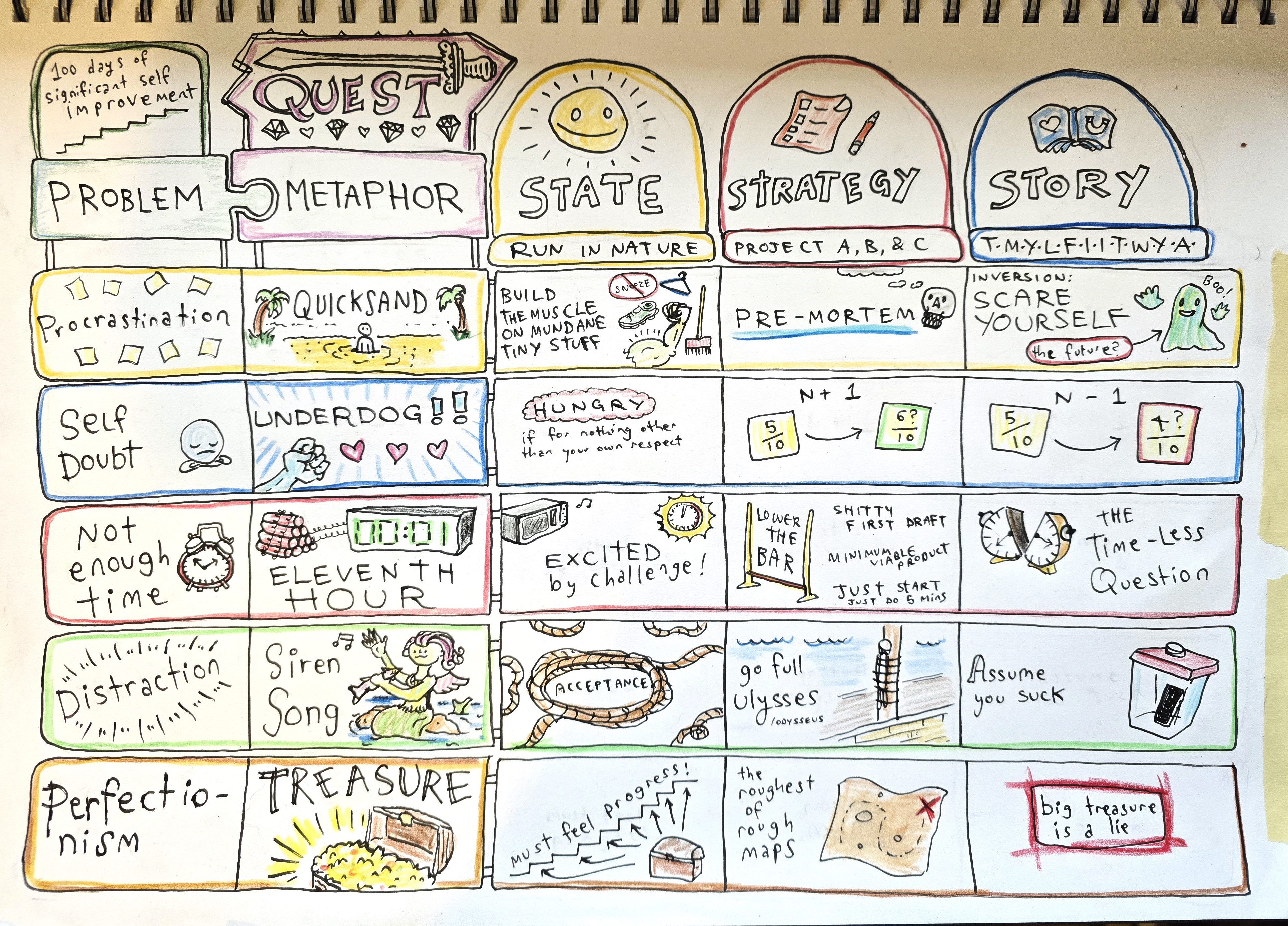
The QUEST framework is designed to help you significantly self-improve by addressing five common obstacles. Each obstacle is represented by a metaphor to make it memorable.
For each, consider your
- State (mindset),
- Strategy (practical actions), and
- Story (narratives you tell yourself).
Q - Quicksand (Procrastination)
Metaphor: Like quicksand, if you do nothing, you sink.
- State: Build Action Muscles
- Strengthen your ability to act by consistently making small, positive choices.
- Example: Instead of leaving clothes on the floor, put them away immediately.
- Strategy: Pre-Mortem Analysis
- Imagine it’s 100 days later, and you’ve failed. Identify what led to failure.
- Recognize personal obstacles like perfectionism or overuse of your phone.
- Story: Visualize the Consequences of Inaction
- Tell yourself a “scary story” about what happens if you do nothing.
- Exercise: Write down the negative outcomes of inaction over the next 100 days.
U - Underdog (Self-Doubt)
Metaphor: Start as the underdog who transforms through overcoming obstacles.
- State: “Enough is Enough” Mindset
- Acknowledge that you can do better and commit to change.
- Strategy: Incremental Improvement (N+1)
- Aim to improve each area of your life by one point.
- Focus on small, achievable steps rather than drastic changes.
- Story: Life Audit with Positive Framing
- Rate life areas (family, fitness, finances) out of 10.
- Ask, “Why didn’t I rate it one point lower?” to recognize existing strengths.
E - Eleventh Hour (Feeling Time-Constrained)
Metaphor: It’s the final hour; urgency can motivate.
- State: Reframe Stress as Excitement
- View time constraints as a challenge that energizes you.
- Strategy: Lower the Barrier to Start
- Use methods like the “5-minute rule” to begin tasks.
- Allow yourself to start imperfectly with a “shitty first draft” or minimum viable effort.
- Story: Challenge Time Assumptions
- Ask, “What’s my 10-year goal? How could I achieve it in 6 months?”
- This breaks limiting beliefs and encourages creative problem-solving.
S - Siren Song (Distraction)
Metaphor: Like sailors tempted by sirens, distractions can lead you astray.
- State: Acceptance of Limitations
- Admit that willpower alone is not enough to resist temptations.
- Strategy: Ulysses Pact
- Remove or restrict access to distractions.
- Examples: Use app blockers, keep your phone out of reach, and avoid stocking unhealthy food.
- Story: Assume You Lack Willpower
- Plan as if you can’t rely on self-discipline.
- Design your environment to minimize temptations.
T - Treasure (Perfectionism and Pressure)
Metaphor: The treasure hunt can create pressure to be perfect.
- State: Focus on Progress Over Perfection
- Recognize that making progress is more motivating than seeking perfection.
- Strategy: Create a Rough Treasure Map
- Develop a flexible plan with clear but attainable goals.
- Methods:
- “Better Than Now”: Identify what would be an improvement over your current state.
- Define What You Don’t Want: Clarify goals by recognizing what you wish to avoid.
- Add Constraints: Limit scope to make goals more achievable.
- Story: Redefine Success
- Understand that the end goal may not bring lasting happiness.
- Ask, “What would I pursue even if I might fail?”
- Value the journey and personal growth over the destination.
How to Use the QUEST Framework
- Identify Obstacles: Recognize which of the five areas resonates most with your current challenges.
- Apply the Three Components:
- State: Adjust your mindset to be conducive to change.
- Strategy: Implement practical steps tailored to each obstacle.
- Story: Rewrite your internal narratives to support your goals.
- Customize Your Plan: Pick and choose the ideas that fit your situation.
- Take Action: Commit to applying these concepts over the next 100 days.
- Reflect and Adjust: Regularly assess your progress and make necessary adjustments.
By integrating the QUEST framework into your self-improvement journey, you can systematically overcome procrastination, self-doubt, time constraints, distractions, and perfectionism. Focus on consistent action, strategic planning, and empowering stories to make the next 100 days transformative.