The Dip — Summary
Summary of Seth Godin's The Dip.
Quit the wrong stuff. Stick with the right stuff. Have the guts to do one or the other
Resilience and Quitting.
Strategic quitting is excellent for success and an intelligent way to manage your life and career.
People who can’t get what they want often quit reactively and repeatedly. They quit when it’s hard and keep going when they should stop.
Persistent people can visualize light at the end of the tunnel when others can’t see it. At the same time, the most brilliant people are realistic about not imagining light when there isn’t any.
The Dip.
The Dip is the challenging phase between starting and mastery, the gap between beginner’s luck and real accomplishment. While starting up is thrilling, it’s not until you get through the Dip that your efforts pay off.
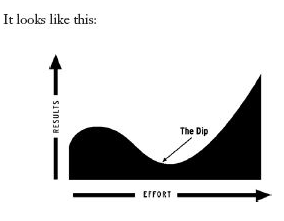
Those who persevere through this phase become better. Moreover, successful people don’t just ride it out; they actively embrace the challenge, understanding that their efforts can make it shorter and more manageable.
The Dip is flexible and responds to the intensity of your effort.
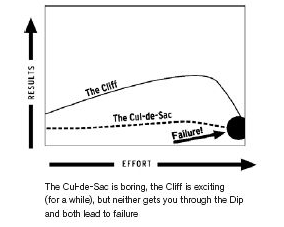
The Dead End.
When you find yourself in a situation where you work, nothing changes — it doesn’t get better or worse; it just is — you need to get out fast because it keeps you from doing something more productive.
The Cliff.
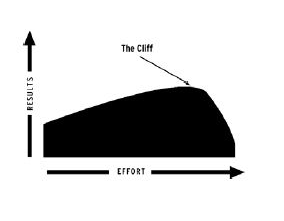
The Cliff is a rare but scary situation where you can’t quit until you fall off and everything falls apart. To mitigate the risk, remember that if it is worth doing, there’s probably a dip.
Knowing When to Quit
The biggest obstacle to success in life is our inability to stop soon enough. Quitting projects that don’t align with your interests, strengths, or long-term goals is essential for focusing on those that truly matter. The opportunity cost of investing your life in something that won’t improve is too high.
To make the most of your resources, consider stopping if you’re:
- On a dead-end path.
- In a Cliff or facing an insurmountable obstacle.
- Working on a project with a Dip, which isn’t worth the reward.
By doing so, you free up your energy to commit fully to the Dips that offer meaningful rewards and opportunities for growth. Pursue your long-term strategy and never quit something just because you can’t deal with the stress of the moment.
Coping is what people do when they muddle through a lousy job or difficult task. It never leads to exceptional performance. Mediocre work is rarely due to a lack of talent and often because of a Dead End. Coping wastes time and misdirects energy. If the best you can do is cope, you’re better off quitting.
Strategic quitting is a conscious decision you make based on available choices. If you realize you’re at a dead end compared with what you could invest in, quitting is a smart choice. You don’t have the time, passion, or resources to excel in everything.
The time to look for a new job is when you don’t need one. The time to switch jobs is before it feels comfortable. Go. Switch. Challenge yourself; get yourself a raise and a promotion. You owe it to your career and your skills.
The Risk of Mediocrity
It’s easier to stick with something we’re used to than quit. Strategic quitting is difficult. It’s easier to procrastinate and settle for mediocrity rather than confront reality. However, these reflexes create scarcity, and scarcity creates value.
The next time you catch yourself being average, realize you have only two good choices: Quit or be exceptional. There’s no reason to keep investing in something that will not improve. The opposite of quitting is an invigorated new strategy to break the problem apart.
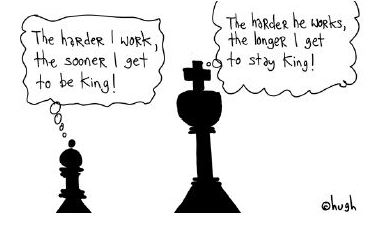
You will achieve extraordinary results if you can get through the Dip and keep going when the system expects you to stop. Short-term pain has more impact on most people than long-term benefits, which is why it’s important to amplify the long-term benefits of not quitting. In a competitive world, adversity is your ally. Its complexity and unpredictability work to your advantage. To be a superstar, you must do something exceptional.
Here are seven reasons you might fail to become the best in the world:
- You run out of time.
- You need more money.
- You get scared.
- You are not serious about it.
- You lose interest or enthusiasm or settle for mediocrity.
- You focus on the short term instead of the long.
- You pick the wrong thing to be the best in the world.
Failure comes from either poor planning or giving up before reaching your goal.
Selecting the Best Opportunities.
The mass market is dying; there are now many specialized micro-markets. Simultaneously, the markets and society create obstacles — Dips — leading to resource scarcity.
Hardworking, motivated people find diversification a natural outlet for their energy and drive. And yet, real success goes to those who obsess and conquer the unknown. Any compromise is a failure. When you frequently quit during the Dip, you become a serial quitter, starting many things but accomplishing little.
Thus, when starting something new, consider the following:
- The brave approach is to push through the Dip and reap the rewards of scarcity.
- The mature approach is only to start if you believe you will survive the Dip.
- The foolish approach is to quit midway, wasting time and resources.
Successful competitors aim to overcome a Dip that is so challenging that emerging competitors struggle to keep up.
All our successes are the same. All our failures, too. We succeed when we do something remarkable. We fail when we give up too soon. We succeed when we are the best in the world at what we do. We fail when we get distracted by tasks we don’t have the guts to quit.
Critical Questions Before Quitting
QUESTION 1: AM I PANICKING?
Panic is never intended. When the pressure is most significant to compromise, to drop out, or to settle, your desire to quit should be at its lowest.
If quitting is going to be a strategic decision that enables you to make intelligent choices, then you should outline your quitting strategy before the discomfort sets in. Otherwise, if you decide based on your feelings, you will probably make the wrong decision.
QUESTION 2: WHO AM I TRYING TO INFLUENCE?
If you’re considering quitting, it’s almost certainly because you’re not being successful at your current attempt at influence.
- Influencing one person is like scaling a wall. You’re in if you get over the wall the first few tries. If you don’t, often you’ll find that the wall gets higher with each attempt.
- Influencing a market, on the other hand, is more of a hill than a wall. You can make progress, one step at a time, and as you get higher, it gets easier.
QUESTION 3: WHAT SORT OF MEASURABLE PROGRESS AM I MAKING?
If you’re trying to succeed in a job, relationship, or task, you’re either moving forward, falling behind, or standing still. There are only three choices. Measurable progress doesn’t have to be a raise or a promotion. It can be more subtle than that, but it needs to be more than a mantra, more than just “surviving is succeeding.”
The seduction of not quitting — and the source of all those stories about sticking it out — almost always comes from people moving through a market.
QUESTION 4: WHAT KIND OF SITUATION AM I TRYING TO QUIT?
Complete the following questionnaire to understand which situation you are trying to quit:
| Question | Answer |
|---|---|
| Is this a Dip, a Cliff, or a Dead End? | |
| How can I change it into a Dip if it’s a Dead End? | |
| Is my persistence going to pay off in the long run? | |
| Am I engaged with just one person (or organization), or do my actions in this situation spill over into the entire marketplace? | |
| When should I quit? I need to decide now, not when I’m in the middle or when part of me is begging to stop. | |
| If I quit this task, will it increase my ability to get through the Dip on something more substantial? | |
| If I’m going to quit anyway, is there something dramatic I can do instead that might change the game? | |
| Is what I’m doing something reasonable? | |
| What chance does this project have to be the best in the world? | |
| Who decides what best is? | |
| Can we make the world smaller? | |
| Does it make sense to submit to every job opening? | |
| If I like my job, is it time to quit? | |
| Is doing nothing better than planning on quitting and then doing something great? | |
| Are you avoiding the remarkable as a way of quitting without quitting? | |
| Does it scare you? If it scares you, it might be worth doing it. |
Annexes
A. Types of Dips
- MANUFACTURING DIP - Ramping up for large-scale production is challenging.
- SALES DIP - It hits when you need to upgrade to a professional sales force and scale it up.
- EDUCATION DIP - It happens when it’s time to learn something new, reinvent, or rebuild your skills.
- RISK DIP - Taking practical risks that are smart moves, not a risky crapshoot.
- RELATIONSHIP DIP - Some people and organizations can help you later, but only if you invest the time and effort to work with them now.
- CONCEPTUAL DIP - You got this far operating under one set of assumptions. Abandoning those and embracing a new, more extensive set is what you need to do to get to the next level.
- EGO DIP - Giving up control and leaning into the organization gives you leverage.
- DISTRIBUTION DIP - Finding a strategy that is effective for you.
Other Ideas to pursue
- Zipf’s law
- The Long Tail (book)
- The Magic of Thinking Big (book)