Combining Zettelkasten and Building a Second Brain
How the two systems compose.
Introduction
Building a Second Brain builds on the tradition of Getting Things Done.
Don’t worry about analyzing, interpreting, or categorizing each point to decide whether to highlight it. That is way too taxing and will break the flow of your concentration. Instead, rely on your intuition to tell you when a passage is interesting, counterintuitive, or relevant to your favorite problems or current project.
BASB is a hybrid of information management and project management systems. It is based on GTD and includes customizations for collecting content for projects.
BASB’s strengths lie in the management of sources of knowledge.
While BASB’s “second brain” doesn’t move beyond the resource, the work with the Zettelkasten begins only after we have extracted the ideas and thoughts from the resource and put each of them on an Atomic Note while leaving behind the resource.
The emphasis of the whole system on action effectiveness is particularly evident through the filing system PARA. The four parts (Projects, Areas, Resources, Archive) are aligned to a hierarchy of urgency.
In contrast, the Zettelkasten Method speaks the “language of knowledge”. In the Zettelkasten, there is no such thing as importance or urgency. Each note merely contains ideas and their connections to other ideas. Their actionability is a second layer that we put onto them.
BASB is for people who want to manage their information streams and resources in a project-oriented way.
How does BASB work?
Like any management system, BASB consists of three components:
- The System. How are the folders, files, inboxes, etc. arranged?
- The Workflow. How do the resources become the desired end result?
- The Habits. What are the regularly recurring actions needed to take to make the system work and be maintained?
The System - PARA
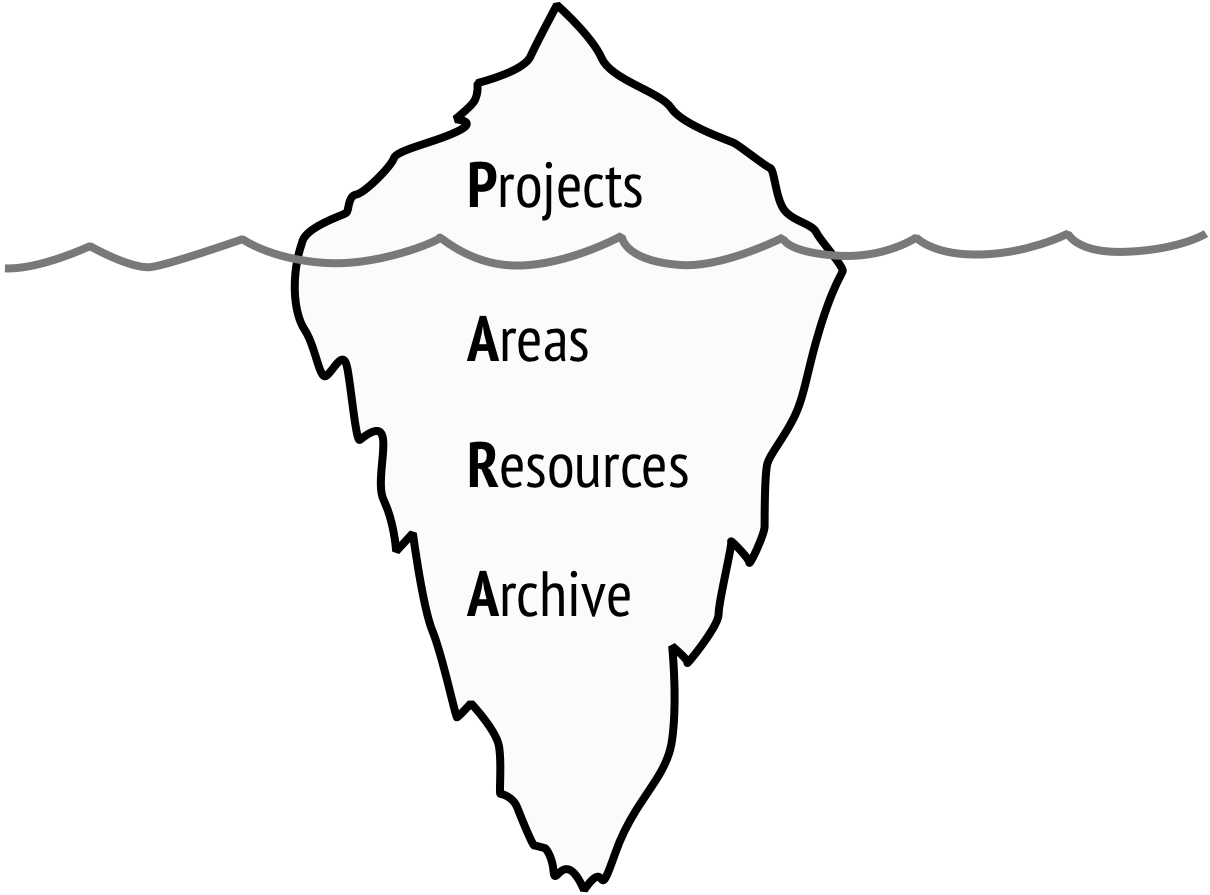
- Projects are short-term efforts in work and personal life.
- Areas (of Responsibility) are concerned with anything that you want to keep in mind for the long term.
- Resources are topics that might become relevant or useful at best in the long run.
- The Archive is for everything inactive from the above three categories.
The workflow - CODE
The BASB workflow is divided into four steps:
- Capture includes everything you fill your inboxes with.
- Organise means filing in the PARA folder system.
- Distill means processing of resources with the method of progressive summarizing.
- Express means the application or publication of content.
When distilling, it is where the difference from the Zettelkasten Method becomes particularly obvious. At no point in CODE do you move beyond the resource inside the system. Only at Express, the next step of CODE, do we leave behind the resource as the unit of information.
With BASB, we get stuck with managing resources because we don’t move beyond the resource. Yet, the method of resource editing is quite easily interchangeable. Even if we process the resource to the point of extracting out each individual thought, as is the case with, let’s say, the Zettelkasten Method, we could still fit the individual thoughts into the PARA system as well. So, progressive summarization is not at all an essential ingredient for BASB to work.
The Key Habits
The Project Checklists
Checklist: Project Start
- Collect: Gather your thoughts about the project. What do you already know about it? What don’t you know? What is your goal? What people can you tap into? What are possible resources?
- Review: Search the folders of your second brain for useful information.
- Search: Use the global search to back up the second step. Sometimes, useful information turns up in surprising places.
- Move: Move all relevant notes to the project folder.
- Create: Create an outline from everything you have collected in the project folder. Important: You are only planning the project. You’re not working on it directly yet.
Checklist: End of project
- Mark: Mark the project as complete in your task management and still process any loose ends.
- Cross out: Mark the goal associated with the project as achieved and move the goal to a “Achieved” list. You can use this list of achieved goals as motivation.
- Review: Review the project folder for content that you can use for other projects.
- Move: Move the project folder from “Projects” (PARA) to the archive (PARA).
- If project is becoming inactive: If you cancel or postpone the project, make sure you can start where you left off. Create a note, with all the necessary information, how you would continue and also with the reasons why you stopped.
Review
Weekly Review
- Empty the email inbox.
- View the calendar.
- Clean up the desk of your computer.
- Empty the inbox of your note-taking software. There is no editing involved! This is just about putting the material into the PARA system.
- Choose the assignments for the week.
Monthly Review
- View and update your quarterly goals.
- View and update your project list.
- View your areas of responsibility.
- View your “someday/maybes.”
- Update how important and urgent the tasks are.
Building a Second Brain and the Zettelkasten Method in comparison
The processing of knowledge, knowledge work, is explicitly not part of BASB. Knowledge work needs to be done, regardless, if you want to actually produce value. So, you will perform the actual knowledge processing outside the BASB system.
The Zettelkasten Method, on the other hand, is a method for processing knowledge. The analysis of single thoughts and their relations to each other is clearly a centerpiece. Project work, on the other hand, is in the periphery. In a way, the ZKM is agnostic to the use of the processed knowledge.
PARA vs Zettelkasten
BASB speaks the language of action. ZKM speaks the language of knowledge. The basic categories of BASB are importance and urgency. These are categories of action. The basic categories of ZKM are atomic thought and its relation to other thoughts. BASB chooses as its filing categories PARA, a folder system that is a hierarchy of urgency. ZKM is a heterarchy of thoughts that can float freely in the ether like in the Platonic world of ideas.
CODE vs Zettelkasten
The workflow CODE is a method of filing edited resources. At no point do you move beyond the resource inside the system. One could argue for it happening at the express step. But this is technically outside the system.
In contrast, the core of ZKM is precisely this processing of resources into individual ideas by extracting them from the resource and connect them to other ideas. Preparing the resource for later use is indeed a feeder method, and publishing content with the help of the Zettelkasten contributes to using and integrating the Zettelkasten. But both of them nevertheless belong to the periphery of the Zettelkasten.
Habits of BASB vs ZKM
BASB and the ZKM are two completely different approaches to working. But their differences don’t come from the fact that they solve the same problem differently, but that they address different parts of the knowledge-based value chain. This makes them not only easily compatible. In fact, I think it is advisable to combine them.
BASB and ZKM
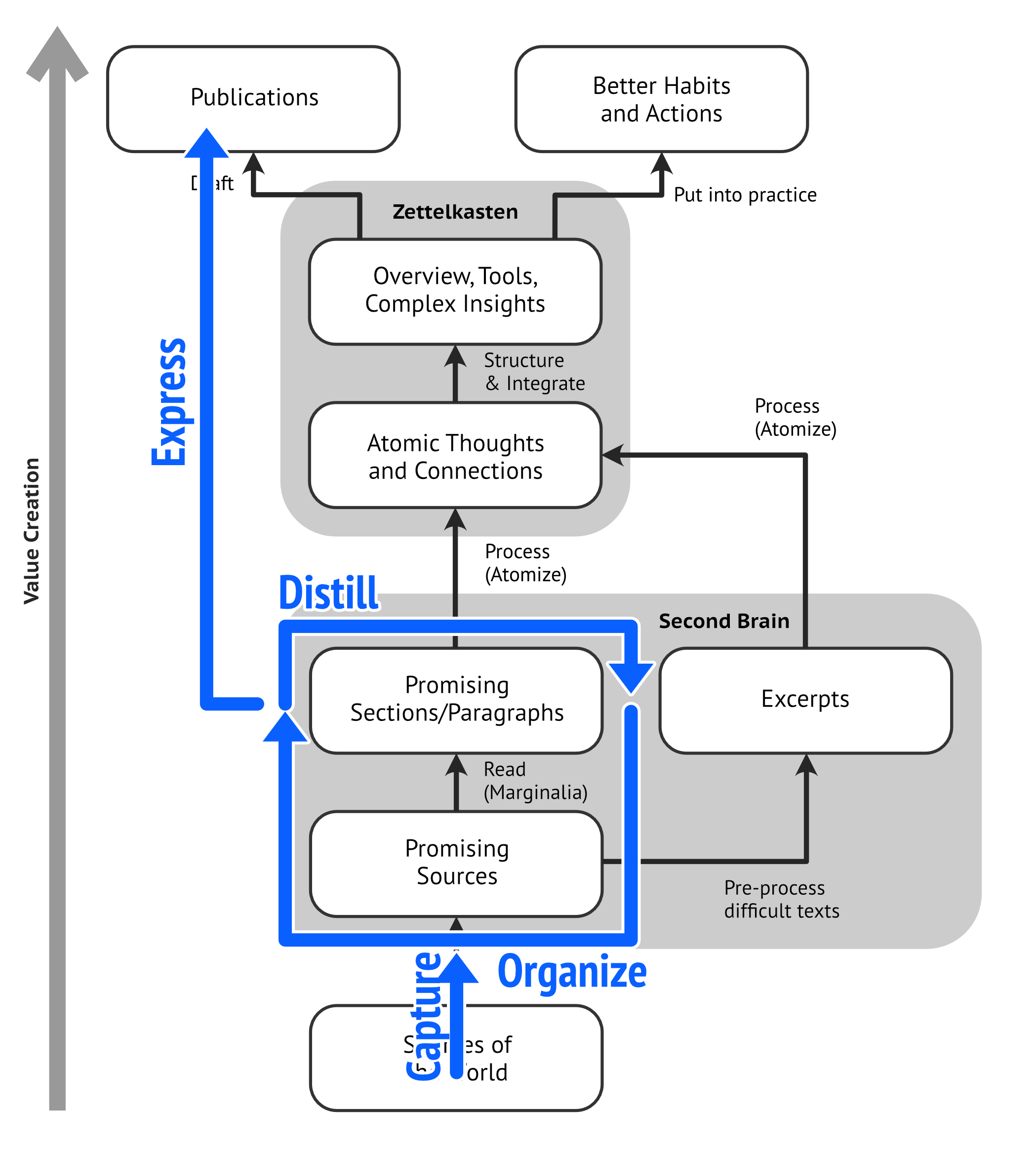 The system and workflow of BASB and the ZKM are easily compatible. We use BASB for organizing resources and excerpts. Our Zettelkasten serves as our integrated thinking environment. Here we process the collected resources and excerpts into atomic thoughts and link them together.
From the PARA system, the Zettelkasten is responsible for both resources and the archive. Projects and areas of responsibility are divided: Content belongs in the Zettelkasten, tasks in the task organisation.
The project habits can be easily transferred to ZKM.
The routine at the start of the project would look like this:
- Create a structure note for your project in the Zettelkasten. This is the place where you collect everything. The difference is that you just create links to needed notes instead of moving the actual files. This applies to notes anyway, but also to excerpts and resources in the form of PDFs, books, etc.
- Collect: Collect everything you know about the project on the structure note.
- Review: Search your notebook for existing knowledge and refer to it from your project structure sheet.
- Search: Systematically search all other places. (Like collections of unread PDFs, link lists, etc.)
- Move: Moving to a project folder is unnecessary. All notes stay where they are.
The result is a note that contains all information about the project. It refers to all notes that are relevant for the project.
The routine at the end of the project, would look like this:
- Mark and Cross Out are part of task management and have nothing to do with the Zettelkasten.
- Review and Move are already partially done, in extreme cases even completely: After all, you have developed all thoughts in the Zettelkasten. They are already in the Zettelkasten and completely integrated into your base network. For every note you write, you can check directly when you create it whether the note is usable for another project. When you finish the project, there’s one thing you can check: if something came up while you were writing the manuscript that you want to feed back into the Zettelkasten. That’s what I call “processing back.”
- If project becomes inactive is superfluous. Everything is in the Zettelkasten anyway.
BASB’s maintenance habit review has nothing to do with processing knowledge, but with project and task management. We use the habits to clean up the PARA system. The Zettelkasten remains unaffected.